The challenge for digital transformation in public administration (article from Joao Frade, EC – DIGIT)

The IDEASFORUM Team happy to share with you this insightful piece from Joao Frade, who is coordinating efforts of the CEF Digital team.
The IDEASFORUM Team happy to share with you this insightful piece from Joao Frade, who is coordinating efforts of the CEF Digital team.
The IDEASFORUM Team happy to share with you this insightful piece from Joao Frade, who is coordinating efforts of the CEF Digital team.

The world of IoT is a scattered landscape characterized by a plethora of standards, platforms and technologies, often siloed into different vertical domains, very often unable to communicate to each other.
The Energy Industry cannot afford to continue being fragmented and it is becoming evident at different levels of the value chain that a protocol- independent semantic layer that can serve as interoperability enabler among different categories of smart devices (which could be co-existing in a specific industry domain, or even operate across different domains) coming from different manufacturers. To achieve this level of interoperability, in 2015 industry and academia decided to work together and drafted the SAREF ontology, with the objective to assure data interoperability, enabling communication between IoT devices using different protocols and standards. A number of industrial players operating in different sectors, after testing and assessing the potential of the ontology, expressed their interest to extend SAREF into other domains, in order to fill the gaps in the semantics not yet covered by their communication protocols. As a result of these initiatives, the framework of the SARGON (Smart eneRGy dOmain oNtology) ontology was drafted and used to extend SAREF for achieving better monitoring and controlling in applications to digitize Smart Grids and implement Building Automation projects. The SARGON ontology is based on several existing industry standards and the work of IoT standardization initiatives, as well as on real use cases. It includes classes, properties and instances specifically created to cover the various categories of devices possibly deployed in Smart Energy infrastructure.
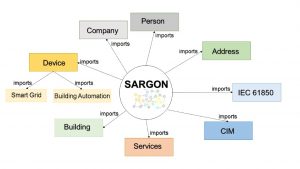
The image above gives a possible picture of the complexity for such a fragmented information domain and all of its components are gathered in the SARGON ontology, which aggregates all these cross-cut domain-specific information.
In addition to this, one of the other major advantages of the SARGON ontology is its modularity, which allows further development of new elements necessary to fill possible gaps and supports any additional development of missing information models, allowing properties and relationships to receive better descriptions, adding additional levels of properties and relationships.
IDEASFORUM is hosting Malileh Haghgoo on October 21st in a Tech-pill focused on introducing the SARGON Ontology to developers of smart energy applications.
Please register here
To access IDEASFORUM Eventbrite page, please click here
The city of Hamburg is a digital pioneer in Germany and its digitalization strategy aims to further improve its urban economic and social scene through new digital services. Engineering provides an Open Source services and Data Platform based on FIWARE integrating data from the Hamburg transparency portal and private sector service offers.
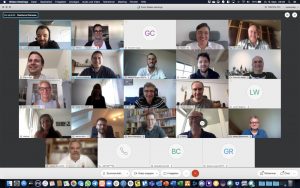
Yesterday, Sep 15th, the promoters of the IDEASFORUM Innovation Hub met in a virtual event hosted by Umagine where members of 18 different organisations discussed on the future goals of the initiatives.
Ulrich Ahle, CEO of the FIWARE Foundation and other members of the Board of Directors joined the event.
The various teams of experts on competence areas will meet in the next few weeks for their internal kick-offs, while the first of the IDEASFORUM public virtual events is scheduled for October 5th, with a presentation on the use of FIWARE generic enablers in smart energy applications (please register here)
.
Recent Comments